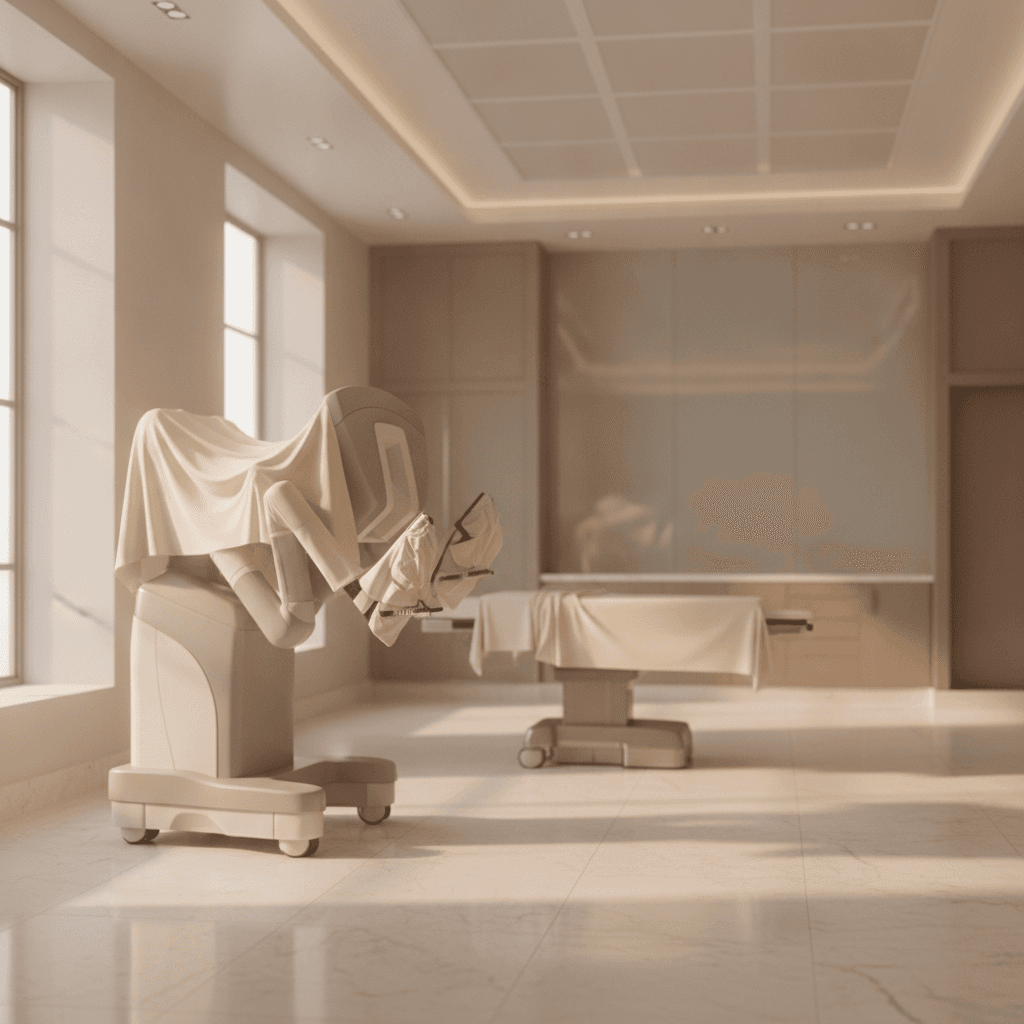
Not long ago, if a patient here in Rockwall, McKinney, or Plano was told they needed advanced robotic surgery, the next sentence often involved a drive into central Dallas — parking garages, traffic on the way to a follow-up, and family members rearranging their whole day. That's changed. I perform robotic-assisted surgery right here in the north and northeast Dallas suburbs, and I want to explain plainly what that technology is, what it actually does for you, and why "near me" and "advanced" are no longer two different things.
The short version: robotic surgery is a precise, minimally invasive way to operate through a few small incisions, and for many patients it means less pain and a faster recovery — and you can now get it close to home.
What Robotic Surgery Actually Is (and Isn't)
Let's clear up the biggest misconception first. A robot does not perform your surgery. I do. The robotic platform is a tool I control, in the room, the entire time — every movement of every instrument comes from my hands.
What the system gives me is a set of advantages over operating the old way. The surgical instruments are mounted on thin robotic arms that pass through small incisions, usually around the size of a fingertip. I sit at a console a few feet away and look through a high-definition, three-dimensional, magnified view of the surgical field — far more detail than the naked eye provides. The instruments themselves bend and rotate more like a human wrist than the rigid tools used in traditional minimally invasive surgery, and the system gently filters out the natural tremor of the human hand.
The simplest way I describe it to patients in the office: robotic surgery lets me do delicate, precise work through tiny openings that would otherwise require a much larger incision. It is an evolution of laparoscopic (minimally invasive) surgery — not a replacement for the surgeon's judgment.
What This Means for You as a Patient
Technology is only worth discussing if it changes your experience for the better. Here's where robotic surgery genuinely tends to help:
- Smaller incisions. Instead of one long incision, most robotic procedures use a few small ones. That means less to heal and a smaller scar.
- Less pain after surgery. Smaller incisions and less disruption to muscle and tissue generally translate into less postoperative pain and, often, a reduced need for narcotic pain medication.
- Faster recovery. Many of my robotic patients go home the same day or after a short stay, walk within hours, and return to desk work and light daily activities noticeably sooner than they would after open surgery.
- Precision in tight spaces. The magnified 3D view and wristed instruments are especially valuable when I'm working around delicate structures — nerves, blood vessels, the edges of an organ — where millimeters matter.
- Lower risk of certain complications. Less tissue trauma and smaller wounds can mean a lower chance of wound infection and, in some procedures, fewer hernias forming at the incision sites later.
I want to be honest about the limits, too. Robotic surgery is not automatically the right choice for every patient or every problem. Some conditions are better treated with a traditional approach, and a previous surgery, certain anatomy, or an emergency situation can change the calculus. Part of my job is telling you straightforwardly which approach is genuinely best for you — not simply defaulting to the newest tool.
The Procedures I Perform Robotically
Across my clinics, several of the most common operations in general surgery are well suited to a robotic approach. These are some of the procedures I routinely perform this way:
- Hernia repair. Inguinal (groin), umbilical, incisional, and ventral hernias are among the most common reasons patients come to see me. The robotic approach lets me place and secure mesh precisely with small incisions, and many patients are pleasantly surprised by how manageable recovery feels. You can read more on our hernia surgery page.
- Gallbladder removal (cholecystectomy). For patients dealing with painful gallstones or gallbladder attacks, robotic gallbladder removal is typically an outpatient procedure with a quick turnaround back to normal life.
- Colon surgery. Removing a segment of colon — for diverticulitis, certain polyps that can't be removed during a colonoscopy, or other conditions — is exactly the kind of operation where robotic precision in a confined space pays off, often with a shorter hospital stay than open colon surgery.
- Anti-reflux and hiatal hernia surgery. For patients whose acid reflux no longer responds well to medication, robotic surgery allows me to repair a hiatal hernia and reconstruct the anti-reflux barrier with the fine control that part of the anatomy demands.
If you're weighing whether an operation is even necessary, that's a separate and important conversation — one I'd rather have face to face than have you settle alone with an internet search.
Why You No Longer Need to Drive Into Dallas
For years, the assumption was that cutting-edge surgical technology lived downtown, at the big medical centers. That assumption is simply out of date. The same robotic platforms used at major academic hospitals are now available in surgical facilities right here in the suburbs, and I operate using them.
For you, staying local isn't just about a shorter drive on the day of surgery — though that matters. It's about the whole arc of care:
- Easier follow-up. Postoperative visits are a few minutes from home, not a half-day expedition.
- Family close by. The people supporting your recovery aren't fighting downtown traffic to be with you.
- Continuity and access. As a boutique practice, my patients across Rockwall, McKinney, Plano, and the surrounding north and northeast Dallas communities get direct access to me — not a rotating cast of providers. The surgeon who meets you in clinic is the one at the console.
Advanced care and a familiar, convenient setting are no longer a trade-off. You can have both, in your own community.
A Few Honest Questions Patients Ask
"Is robotic surgery safe?" Yes. It's a well-established, widely used approach with a strong safety record across the procedures I've described. As with any surgery, the most important safety factor is the experience and judgment of the surgeon performing it.
"Will it cost more?" For most patients, robotic procedures are covered the same way the equivalent traditional surgery would be, because the operation itself — the hernia repair, the gallbladder removal — is what's being treated and billed. Coverage always depends on your specific plan, and our team is glad to help you verify your benefits in advance.
"How do I know if I'm a candidate?" That's exactly what a consultation is for. I'll review your history, examine you, and tell you honestly whether a robotic, laparoscopic, or open approach gives you the best result.
Let's Talk About Your Options
If you've been told you need surgery — or you're dealing with a hernia, gallbladder trouble, persistent reflux, or a colon condition and aren't sure what comes next — you don't have to leave your community to get advanced, thoughtful care.
At Abbassi Surgical Associates, patients from Rockwall, McKinney, Plano, and across north and northeast Dallas get a straightforward conversation with a board-certified general and robotic surgeon about what's actually best for them. We see patients at all three clinic locations and offer same-week consultations. To talk through your options, request a consultation or call us at (469) 203-8856. I'd be glad to help you understand exactly what you're looking at — close to home.
Dr. Abbassi sees patients at our Plano clinic and across North Texas. To discuss your options, schedule a surgical consultation or call (469) 203-8856.
Dr. Babak Abbassi, MD, MBA, MS
Board-certified general surgeon specializing in minimally invasive and robotic surgery in Rockwall, McKinney, and Plano, TX.
About Dr. Abbassi